
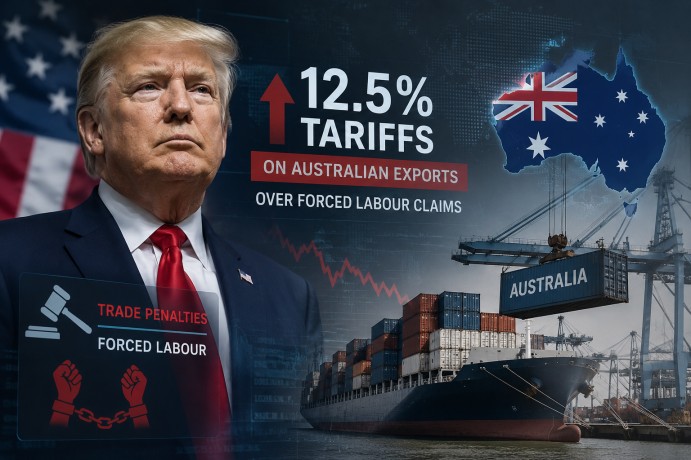
The United States has announced a 12.5% tariff on numerous Australian exports, alleging that Australia has not adequately addressed the issue of forced labour in its supply chains. The Australian government has responded by denouncing the tariffs as unjust and incompatible with the Australia-U.S. Free Trade Agreement. Trade Minister Don Farrell emphasized that Australia has robust laws against forced labour and modern slavery, urging the U.S. to revoke the tariffs without delay.
This new tariff impacts a variety of Australian exports, although exceptions have been made for significant sectors like beef, gold, and several agricultural products, as well as aircraft parts and certain mineral and industrial goods. Australian officials have expressed their discontent, claiming the decision is unfounded and warning it could strain trade relations between the two nations. The measure has also faced backlash from business groups and industry leaders in Australia, who argue that the tariffs are unjust and detrimental to exporters.
The tariffs are part of a broader strategy by the Trump administration to enforce trade measures addressing concerns about forced labour, affecting numerous countries globally. Despite the U.S. administration’s stance, Australian officials maintain that there is a lack of evidence to justify these new tariffs and are seeking to engage in dialogue with Washington to resolve the issue. The imposition of these tariffs has prompted a robust response from various sectors in Australia, emphasizing the potential negative impact on bilateral trade.
While the U.S. continues to expand its trade enforcement policies, Australia stands firm on its commitment to combating forced labour through existing stringent laws. The Australian government is advocating for a review of the tariff decision, emphasizing the importance of maintaining a fair and mutually beneficial trade relationship. As discussions unfold, the focus remains on finding a resolution that respects international trade agreements and addresses the concerns raised by both nations.